


Single-mass flywheel: how it works, advantages, disadvantages and common faults
Available languages:


Single-mass flywheels are part of the clutch and drivetrain design in many passenger cars, vans and light commercial vehicles. They store rotational energy and provide the friction surface for power transmission. Compared with a dual-mass flywheel, their design is simpler. However, this does not mean that a single-mass flywheel is fundamentally the better solution for every vehicle.
Typical damage occurs due to thermally damaged friction surfaces, mechanical wear or damaged teeth on the starter ring gear. Vibrations, clutch judder or uneven power transmission may indicate problems in the area of the single-mass flywheel and clutch. However, noises cannot automatically be attributed to the flywheel: The clutch disc, release system, transmission, engine operation or mountings may also be possible causes.
In this article, you will learn how a single-mass flywheel is designed, how it differs from a dual-mass flywheel, what advantages and disadvantages both systems have, and how to properly inspect a flywheel in the workshop.
For precisely these types of repair cases, VAICO offers single-mass flywheels for numerous vehicle applications. They enable the replacement of worn or damaged flywheels in the independent aftermarket and, when correctly matched to the specific vehicle, can be an economically attractive alternative to repairs using the original part.
In brief: A single-mass flywheel is a rigid flywheel mounted on the crankshaft. It stores rotational energy, stabilises engine operation, forms the friction surface for the clutch and carries the ring gear for the starter motor. In this design, torsional vibrations are primarily damped by the clutch disc and its torsional damper.
What is a single-mass flywheel and how does it work?
The single-mass flywheel consists of a single flywheel rigidly connected to the crankshaft. Depending on the vehicle design, it is bolted to the crankshaft flange connection. Its mass and geometry are matched to the respective engine and drivetrain.
The main functions of the single-mass flywheel are:
- Storing rotational energy: The flywheel supports smooth engine operation between individual ignition events.
- Stabilising crankshaft rotation: Speed and torque fluctuations are smoothed by the rotating mass.
- Providing the clutch friction surface: The clutch disc is pressed against the friction surface of the flywheel together with the pressure plate.
- Transmitting engine torque: When the clutch is engaged, engine torque is transmitted via the friction connection to the clutch disc and from there via the clutch hub to the transmission input shaft.
- Starter ring gear: The outer ring gear allows the starter pinion to engage and thus enables the engine to be started by the starter motor.

The single-mass flywheel does not work alone. In many applications, the clutch disc provides an important part of the torsional vibration damping. For this purpose, it has torsion springs between the hub and the lining carrier. These springs can reduce torque peaks and vibrations in the drivetrain. The extent to which the system dampens vibrations depends on the specific vehicle and clutch design.
Single-mass flywheel or dual-mass flywheel?
The most important difference between a single-mass flywheel and a dual-mass flywheel lies in their design and damping. In a single-mass flywheel, the flywheel mass is rigid. A dual-mass flywheel, on the other hand, consists of a primary and a secondary mass that can move relative to each other within a defined range. Springs and other damping elements reduce torsional vibrations before they reach the transmission.
| Characteristic | Single-mass flywheel | Dual-mass flywheel |
|---|---|---|
| Design | One rigid flywheel mass | Two flywheel masses that can move relative to each other |
| Damping | Primarily via the clutch disc and torsional damper | Integrated damping system in the flywheel |
| Construction | Simpler design | More complex design |
| Torsional vibrations | May be more noticeable depending on the vehicle | Generally damped more effectively |
| Comfort | Depends on the engine, clutch and vehicle design | Designed for a high level of smoothness and comfort |
| Inspection | Check friction surface, runout and ring gear | Additionally check play, spring action and other dual-mass flywheel characteristics |
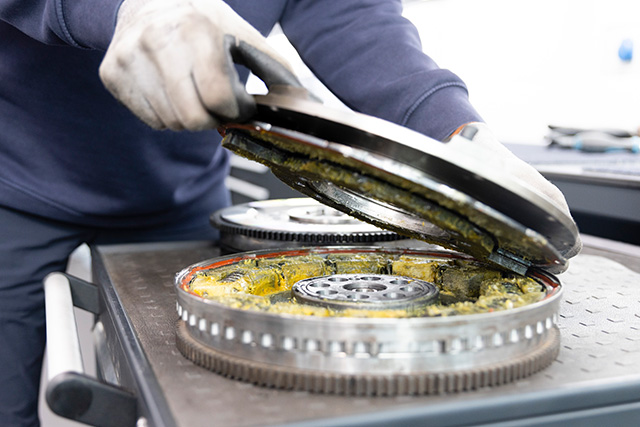
Single-mass and dual-mass flywheels therefore perform the same basic function, but differ significantly in terms of damping. If you would like to learn more about the operating principle and typical damage patterns of dual-mass flywheels, you will find further information in the article Flywheels from VAICO. Read the article “Dual-mass flywheels from VAICO”
Single-mass flywheel: advantages and disadvantages
Due to its simple design, a single-mass flywheel offers several practical advantages. However, whether these advantages outweigh the disadvantages in a specific vehicle always depends on the original design and the particular repair case.
Advantages of the single-mass flywheel
- simpler design
- fewer moving components inside the flywheel itself
- fundamentally robust design
- generally easy to inspect when used in a suitable application
- often economically attractive, especially for older vehicles
Disadvantages of the single-mass flywheel
- Torsional vibrations are not reduced by an integrated damping system in the flywheel.
- Depending on the engine and vehicle, torsional vibrations as well as noise and vibration sensations in the drivetrain may be more noticeable.
- Noise and comfort characteristics depend more heavily on the interaction between the engine, clutch, transmission and mountings.
- Not every vehicle design is suitable for a single-mass flywheel.
- When converting from a dual-mass flywheel to a single-mass flywheel, driving and noise characteristics may change.

A single-mass flywheel is therefore not categorically better or worse than a dual-mass flywheel. The decisive factors are the vehicle design, engine characteristics, clutch system and the specific repair case.
Single-mass flywheel defective? Symptoms, noises and possible causes
Problems in the area of the single-mass flywheel and clutch can manifest themselves through several irregularities. However, many of these symptoms also occur with a worn clutch or faults in adjacent components.
Possible symptoms of a damaged single-mass flywheel include:
- Unusual noises in the area of the clutch and drivetrain
- Vibrations in the clutch or drivetrain area
- Clutch judder when moving off
- Uneven power transmission
- Noises when engaging the clutch or switching off the engine, the cause of which must be isolated
- Knocking, grinding or scraping noises when starting, which may indicate a problem with the ring gear or starter pinion
- Visible thermal or mechanical damage to the friction surface
- Recurring clutch wear after a repair
A single-mass flywheel is a rigid flywheel mass without internal damping elements such as those found in a dual-mass flywheel. It generally does not produce a clearly characteristic rattling or clattering noise. Damage to the friction surface, excessive runout or thermal overload, on the other hand, are more likely to result in clutch judder, vibrations or uneven power transmission than in a clearly identifiable flywheel noise. Rattling or clattering at idle often originates from adjacent components such as the clutch disc, release system, transmission, engine operation or mountings and should therefore be checked systematically.
A damaged ring gear, on the other hand, can cause knocking, grinding or scraping noises when starting. If the starter pinion does not engage properly, repeated starting problems may also occur.
Inspecting a single-mass flywheel: These types of damage are relevant
The inspection is generally carried out after the transmission and clutch have been removed. Before reusing a flywheel, the entire friction surface, including the ring gear and mounting area, should be checked.
Checking the friction surface
Pay particular attention to:
- bluish or dark discolouration caused by intense heat exposure
- individual hot spots
- deep grooves or pronounced unevenness
- cracks and breakouts
- material transfer from the clutch disc
- an uneven or heavily worn friction surface
- signs of overheating or clutch slip
Slight discolouration is not always sufficient reason for replacement. The decisive factor is whether the surface is within the permissible wear and geometry limits. These values must be assessed according to the manufacturer’s specifications or the specifications for the specific application.
Checking the ring gear and starter area
Check the ring gear all the way around for:
- damaged or broken teeth
- severe uneven wear
- burr formation
- uneven marks from the starter pinion
Damaged teeth can cause starting noises and problems when the starter engages. Depending on the design, the ring gear may be an integral part of the flywheel or designed as a separate component. This is another reason why you should observe the relevant repair instructions.
Consider runout and mounting
Depending on the design, runout, concentricity, mounting holes and the condition of the contact surface may also be relevant. A flywheel with excessive lateral runout or damaged mounting must not simply be reinstalled.
The specific measuring method and permissible limit values depend on the vehicle and flywheel design. General empirical values do not replace the manufacturer’s technical data.

When does a single-mass flywheel need to be replaced?
A single-mass flywheel does not automatically need to be replaced every time the clutch is changed. However, its condition should always be checked when the clutch is removed. This helps prevent a new clutch from being installed on a damaged friction surface.
The service life of a single-mass flywheel cannot be defined generally in terms of a specific mileage. Its service life depends, among other things, on the engine, vehicle weight, driving style, clutch load and operating conditions. Unlike the clutch disc, the flywheel is not replaced at a fixed interval but is inspected during a clutch repair to assess its condition.
Replacement is particularly advisable in the case of:
- cracks or breakouts
- severe thermal damage and pronounced hot spots
- deep grooves or impermissible unevenness
- runout or wear limits that cannot be maintained
- a damaged or severely worn ring gear
- damage to mounting or contact surfaces
- a friction surface whose permissible wear or geometry limits have been exceeded
A damaged flywheel can contribute to clutch judder, uneven power transmission and premature wear of the new clutch. The decision to replace it should therefore not be based solely on its external appearance, but on the damage pattern and the manufacturer’s specifications.
Resurfacing a single-mass flywheel: Is machining possible?
This is generally not recommended. Resurfacing removes material from the friction surface, which can alter the geometry between the flywheel, clutch disc and pressure plate. Without clear manufacturer specifications regarding machining limits, runout and, where applicable, step height, there is a risk of clutch judder, uneven power transmission or renewed wear. In the case of thermal damage, cracks, severe hot spots or deep grooves, the flywheel should not be machined but replaced.

V10-5269, suitable for AUDI, SEAT, SKODA, VW
Single-mass flywheels from VAICO
VAICO offers high-quality single-mass flywheels for numerous common vehicle applications – from small cars and compact vehicles to vans and light commercial vehicles. They are suitable for replacing worn or damaged original parts and thus fill an important gap in the independent aftermarket. Especially when suitable single-mass flywheels are only available to a limited extent, VAICO provides workshops with a reliable and economically attractive alternative to the often more expensive repair using the original part. When correctly matched to the specific vehicle, the flywheels enable repairs without compromising on dimensional accuracy or quality.
Vehicle data, engine and transmission variant, year of manufacture, OE references and the specific clutch design are decisive for selection. A flywheel should therefore not be selected solely based on its diameter or external shape. You can find an overview of the available applications in the VAICO flywheel range.
Converting from a dual-mass flywheel to a single-mass flywheel
For selected applications, VAICO also offers solutions for converting from a dual-mass flywheel to a single-mass flywheel. Such a conversion is always dependent on the specific vehicle, engine, transmission and kit used.
Depending on the design, the use of the original clutch components may be intended. However, this only applies if it is expressly specified for the respective conversion kit. Combining arbitrary individual parts is not a reliable repair strategy.
A conversion from a dual-mass flywheel to a single-mass flywheel can be an interesting repair solution for older vehicles or vehicles with a lower residual value. At the same time, the noise, vibration and comfort characteristics may change compared with the original design. Whether the conversion makes sense should therefore be decided based on the application, vehicle condition and the customer’s expectations.
Inspect and replace the single-mass flywheel correctly
A single-mass flywheel is a robust, structurally simple flywheel mass in the clutch system. It stores rotational energy, stabilises engine operation, transmits engine torque and provides the friction surface for the clutch.
Despite its simple design, it can be damaged by overheating, clutch slip, mechanical damage or a worn ring gear. Noises, vibrations and clutch judder provide important indications, but alone are not sufficient for a reliable diagnosis.
Therefore, check the friction surface, ring gear, runout and mounting according to the specifications for the respective application.
Not every flywheel needs to be replaced automatically when the clutch is changed. However, resurfacing should generally be avoided without clear manufacturer specifications regarding machining limits, runout and, where applicable, step height. In the event of relevant damage or exceeded limits, a suitable replacement part is the proper professional solution. For selected vehicle applications, VAICO offers single-mass flywheels and conversion solutions for the independent aftermarket.
Would you like to avoid missing new technical articles, videos and practical repair solutions? Then sign up for our newsletter. This will keep you up to date with current workshop topics, new blog posts and technical tips relating to everyday workshop operations.

FAQ about single-mass flywheels
How can you identify a defective single-mass flywheel?
Possible indications include vibrations, clutch judder, uneven power transmission or visible damage to the friction surface. Noises may also occur, but cannot be clearly attributed to the single-mass flywheel. The clutch, transmission, engine operation or mountings may also be possible causes. A reliable diagnosis therefore requires inspection of the entire relevant drivetrain.
Which noises may indicate problems in the area of the single-mass flywheel and clutch?
A damaged ring gear can cause knocking, grinding or scraping noises when starting. Damage to the friction surface, excessive runout or thermal overload, on the other hand, are more likely to result in clutch judder, vibrations or uneven power transmission than in a clearly identifiable flywheel noise. Rattling or clattering at idle often originates from adjacent components such as the clutch disc, release system, transmission, engine operation or mountings and should therefore be checked systematically.
Does the single-mass flywheel also need to be replaced when changing the clutch?
No. The flywheel does not automatically need to be replaced every time the clutch is changed. However, it should be removed and checked for thermal damage, grooves, cracks, runout, ring gear condition and other damage.
How long does a single-mass flywheel last?
A fixed mileage cannot be specified. The service life depends, among other things, on the engine, vehicle weight, driving style, clutch load and operating conditions. Unlike the clutch disc, the flywheel is not replaced at a fixed interval but is inspected during a clutch repair to assess its condition.
Can a single-mass flywheel be resurfaced?
This is generally not recommended. Resurfacing removes material from the friction surface, which can alter the geometry between the flywheel, clutch disc and pressure plate. Without clear manufacturer specifications regarding machining limits, runout and, where applicable, step height, there is a risk of clutch judder, uneven power transmission or renewed wear. In the case of thermal damage, cracks, severe hot spots or deep grooves, the flywheel should not be machined but replaced.
Can a dual-mass flywheel be replaced with a single-mass flywheel?
There are suitable conversion kits for selected vehicles. Suitability must always be checked based on the specific application. Depending on the design, the noise, vibration and comfort characteristics may change compared with the original vehicle design.